
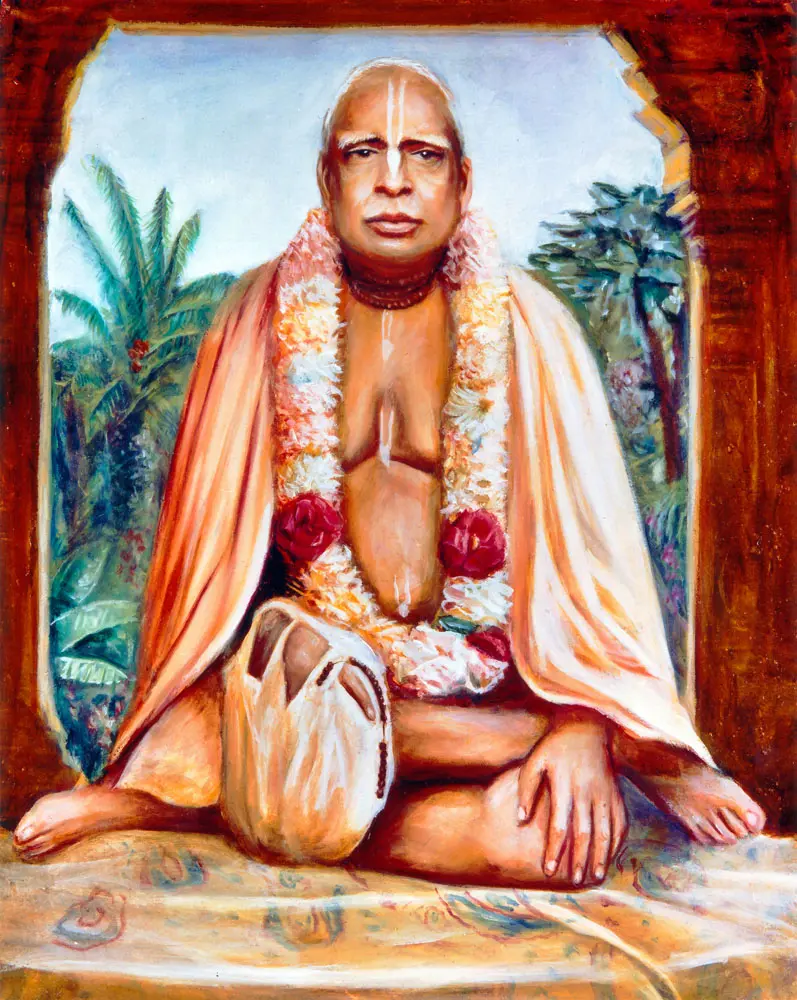
The Pioneer of Modern Bhakti
Śrīla Bhaktivinoda Ṭhākura.
"The Seventh Goswami who bridged the gap between ancient Vedic wisdom and the modern world."
A Life of Divine Purpose
He was born as Kedarnath Datta in 1838 in Ula, Birnagar (Nadia district, Bengal) and passed away in 1914. He was a householder, magistrate, scholar, poet and preacher in the line of the Gaudiya Vaishnava tradition, and is regarded as one of the prominent acharyas in the disciplic succession from Lord Krishna. He re-introduced the full teachings of Sri Chaitanya Mahaprabhu, wrote extensively, composed devotional songs, and laid foundations for Krishna-consciousness in the modern world.
According to the Gaudiya Vaishnava sources, Srila Bhaktivinoda Thakura’s eternal form is that of a direct servant in the spiritual world: specifically he is called “Kamala Manjari” the confidential maidservant of Rupa Manjari (who in turn serves Srimati Lalita-sakhī in Vraja). Thus his eternal service is to serve the Divine Couple (Sri Sri Radha-Krishna) through the mood of Lalita-sakhī’s party, fulfilling devotional service in the infinite spiritual realm.
Legacy
- Discovered Birthplace of Lord Chaitanya
- Role The Seventh Goswami
- Son Srila Bhaktisiddhanta Saraswati
- Dream World-wide Nama Hatta
The Golden Light Across the Jalangi
While residing at Svananda Sukhada Kunja, Srila Bhaktivinoda Thakura beheld Sri Chaitanya and Nityananda Prabhu dancing in a brilliant golden light.
This led to the identification of the Yoga Pitha, the actual birthplace of Lord Chaitanya, which he later confirmed with Jagannatha Dasa Babaji Maharaja.
"When will that day come when the fair-skinned foreigners will come to Sri Mayapur-dhama and join with the Bengali Vaishnavas to chant, Jaya Sacinandana!" [cite: 36]
He foresaw a temple whose splendor would broadcast the service of Lord Gaurāṅga throughout the world[cite: 23].
Life's Achievements
• He held high civil-service positions under British colonial rule as Deputy Magistrate and Deputy Collector in Bengal and Orissa.
• He was a prolific writer and scholar: he wrote many books, translations and commentaries, and composed hundreds of devotional songs.
• He used his government office to reform temple worship and maintain standards of deity service: for example, when manager of the Jagannatha Puri temple he established regular worship and daily discourses.
• He discovered and excavated the birthplace of Sri Chaitanya (in Mayapur, Navadvipa).
He revived pure devotional service (śuddha-bhakti) in his era, when the Gaudiya movement had degenerated; he re-emphasised the philosophy of achintya-bheda-abheda and sankīrtana of the holy name.
• He established the “Nama-Hatta” centres for chanting and preaching in Bengal.
• He served as an acharya in the disciplic line (guru-parampara) and his 7th son was Srila Bhaktisiddhanta Saraswati Thakura, who carried forward his mission; hence Bhaktivinoda is recognized as the root of the modern Gaudiya preaching movement.
Literary Masterpieces
-
1886
Sri Caitanya Siksamrta
-
1896
Jaiva Dharma
-
1880
Sri Krishna Samhita
-
1900
Sri Harinama Chintamani
-
1893
Bhakti Tattva Viveka
-
1895
Amrita Pravaha Bhashya of Sri Caitanya Caritamrta
-
1881-1893
Sharanagati, Kalyana Kalpataru (song collections)
Wisdom for the Soul
"Give up all false pride. Always think yourself to be worthless, destitute, lower and more humble than straw in the street."
"Practice forgiveness like the tree. Knowing that Lord Sri Krishna lives within all living beings, you should respect and honor everyone at all times."
Preaching Legacy
Srila Bhaktisiddhanta Saraswati Thakura, carried this mission forward.
"He reasons ill who tells that Vaishnavas die, When thou art living still in sound!"